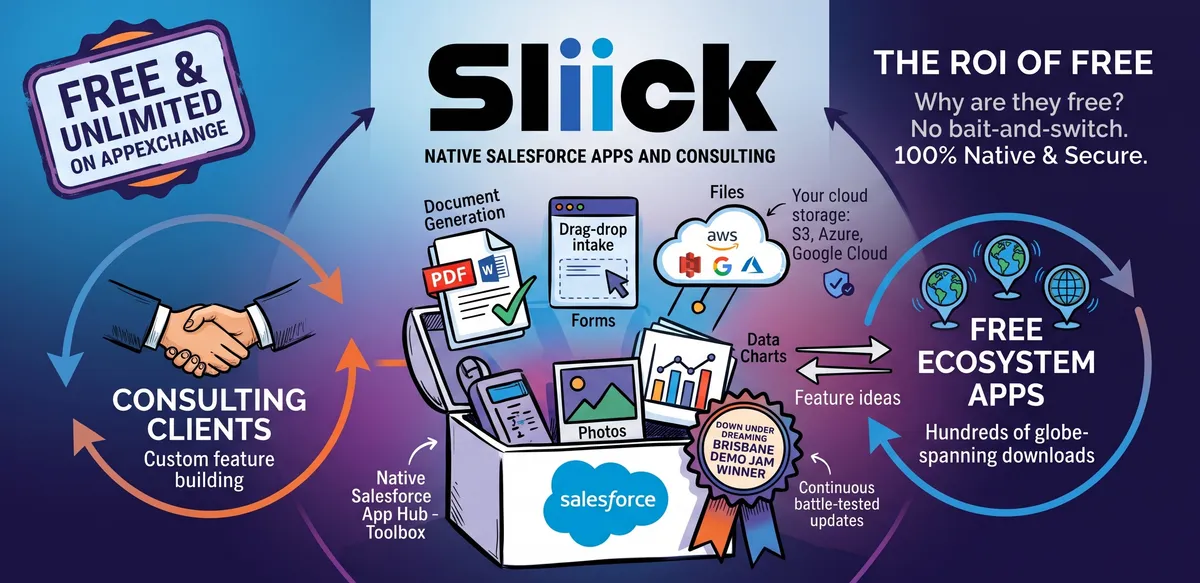
I get asked this question a lot. Going in, I thought free apps would be a sure hit. Who would say no to five capable Salesforce apps (Sliick Docs with native e-signature, Forms, Files, Photos and Charts) with no licence fee? It turns out “selling” free apps is harder than I expected. When IT directors, architects and operations leaders first see them, their reaction is more often scepticism than excitement.
In the Salesforce ecosystem, enterprise software is almost always priced per user, per month, with steep annual minimums. So when a team discovers full-featured, AppExchange-reviewed native apps at zero licence cost, they naturally pause and look for the catch.
In hindsight, I should have seen it coming. Before founding Sliick, I spent years leading the AppExchange technical team in APAC. I saw firsthand how hard it was for teams to close everyday operational gaps in Salesforce without blowing out their software budgets, and I also saw the free tools that let them down. Buyers have good reason to be wary.
When I started Sliick, I decided to test a different kind of business model. Our revenue comes from Salesforce consulting and implementation, not software licences. That single structural choice allows us to give away genuinely capable apps, and it changes the equation for every organisation that installs them.
But free is not the point. We are not building cheap alternatives that are good enough for the price. We are building each app to be the best in its category, full stop: Sliick Docs measured against every document generation tool on AppExchange, Sliick Forms against every form builder, paid or not. Free removes the barrier to trying them but quality is why teams keep using them.
Here is how the model works, why it is sustainable, and what it means for your team.
1. There Is No Bait-and-Switch
The most common fear with free AppExchange tools is the hidden paywall: you embed an app into your daily operations, only to be hit with user caps or surprise pricing six months later.
We do not need that trap, because our software does not carry our payroll. Early on, while most of the ecosystem was still treating AI as simple code autocomplete, we invested heavily in agentic development workflows. That drastically compressed the time and cost required to architect, test and maintain native Lightning Web Components and Apex packages. Because our R&D overhead is a fraction of a traditional ISV’s, we do not need millions in recurring per-user fees just to keep the lights on.
So there are no user caps and no per-seat fees on the core apps. Building templates and generating documents, building and processing forms, storing files in your own cloud, managing photo galleries, charting your records: all of it costs nothing to install and run in production.
We are just as upfront about what is not included. A handful of premium features, such as high-volume document rendering, Adobe-trusted certified signatures, two-way file sync and the offline mobile forms app, involve real infrastructure with real running costs. We tell you which features those are before you install, on each product page, and they are a conversation with our team rather than a meter that starts running once you depend on the app.
2. You Know Exactly Where Your Data Goes
In enterprise IT, “free” often raises an immediate red flag around data privacy: If we aren’t paying for the product, are we the product?
With Sliick, the answer is no. Every Sliick app is built natively on Salesforce and has passed the official Salesforce AppExchange Security Review. The apps are native by default: generating a PDF in Sliick Docs, processing a Sliick Forms response or charting your records all happens inside your Salesforce org.
Where an app does connect out, we name it, and it goes to infrastructure you control or a service with a single, stated job, never a data pool we mine. Sliick Files and Sliick Photos store your files in your own cloud storage (AWS S3, Azure, Google Cloud or SharePoint). Sliick Photos, optionally, uses a media-processing service we run to resize and convert your images. Sliick Forms can host a public form on Sliick Edge if you would rather not run an Experience Cloud site. And the premium document options in Sliick Docs are opt-in and use our managed rendering service. Your data is never sold, shared or used for anything other than the job you asked the app to do.
3. Battle-Tested by Our Own Paying Clients
Another legitimate concern for any Salesforce architect is abandonware. Salesforce pushes three major releases every year, and a free app maintained as a weekend side project can become a liability fast.
At Sliick, our apps are not side projects. They are the exact foundation we use to deliver work for our paying consulting clients. When a client hires us for a complex implementation, we frequently use our apps to accelerate delivery and build new features around their specific operational needs. Crucially, the enhancements and edge-case fixes we build in those engagements almost always flow back into the public packages on AppExchange.
Because our reputation with paying clients depends on these apps running reliably every single day, every user around the world benefits from continuous, CTA-architected updates and release readiness.
4. Clear Boundaries, and Growing Momentum
Using consulting to fund feature-rich software isn’t a traditional SaaS playbook, and we are transparent about how the business works. You can install our apps, follow our documentation and run them in production without ever speaking to a salesperson.
Free apps did not sell themselves, and that is fair: buyers rightly take time to evaluate tools before trusting them in production. Once teams look under the hood, however, the momentum speaks for itself: hundreds of organisations globally now run Sliick apps in their orgs, inbound interest across our site has surged, and we recently won the Demo Jam at Down Under Dreaming in Brisbane, voted on live by the Salesforce community.
When an organisation does need extra hands, whether to design complex architectures, integrate external systems or handle ongoing managed services, many choose to work with us because they have already seen our engineering quality firsthand. And if you have an internal team that wants to extend the apps independently, you have everything you need to run with them on your own.
Is This the Future of App Development?
Zooming out, our approach reflects a much broader shift happening across enterprise software.
With agentic AI and modern tooling, the barrier to building reliable software has dropped dramatically. And when the barrier to development drops, the bar for paid software shoots up. IT and finance leaders are no longer willing to pay an escalating per-user “Salesforce tax” for standard utilities like document generation, record-level charts or file storage connectors. If a vendor is charging steep recurring licences today, they have to innovate relentlessly and deliver deep, unmistakable value, or risk becoming obsolete.
Not every company wants to build internal tools from scratch, and not every team can afford a full-time Certified Technical Architect on staff. By decoupling our revenue from software licences and anchoring it in high-trust consulting, we give teams the best of both worlds: enterprise-grade native tools with zero friction, backed by the architects who built them.
Where to Start
- See the apps: all five apps, each with its own documentation, release notes and a clear list of what is premium.
- Need a hand with your Salesforce: see how we work with organisations in your industry, or talk to us about your project.
We'll audit your architecture, security, and integration posture.